# 14 The Jumps That Looked Impossible (And What It Taught Me About Fear)
"We don’t see things as they are, we see them as we are.”
- Anaïs Nin
The Filter That Quietly Shapes Your Life
There is something quietly influencing how you experience your life.
It’s not obvious, and it’s not something most of us were ever taught to notice, yet it shapes what you pay attention to, what feels threatening, what feels possible, and even what you believe you are capable of doing.
Most of the time we move through our lives assuming we are seeing reality as it truly is, reacting to events as they happen and responding to the circumstances in front of us, but the truth is that our experience of the world is always filtered through the nervous system first.
There is a small network in the brainstem called the Reticular Activating System, or the RAS, whose job is to decide which pieces of information coming into your system actually reach your conscious awareness. Every second your senses are absorbing millions of signals - changes in light, sounds in the distance, the feeling of your clothes on your skin, subtle shifts in tone or expression from the people around you. If you consciously registered all of it, your mind would be overwhelmed within seconds.
So the brain filters.
It selects what appears important and lets everything else fade quietly into the background.
Most people have experienced this effect without realising what was happening. You decide you want a new car, perhaps a very specific model or a colour you had never particularly paid attention to before, and suddenly you begin noticing that car everywhere. It’s at the traffic lights in front of you, parked at the supermarket, driving past you on the highway.
For a moment it can feel almost strange, as though the world suddenly filled with that exact car overnight.
But the truth is those cars were always there.
What changed was your filter.
Your brain simply decided that this particular detail was now important, so your awareness began highlighting it.
The same process is happening constantly in your life.
The beliefs you carry about yourself, the expectations you hold about what is possible, and the experiences that have shaped your nervous system quietly instruct your brain what to prioritise. Your perception begins organising itself around what feels familiar or significant, and slowly, almost imperceptibly, the world you experience begins to reflect those internal patterns.
I saw this play out in my own life long before I had any language for the neuroscience behind it.
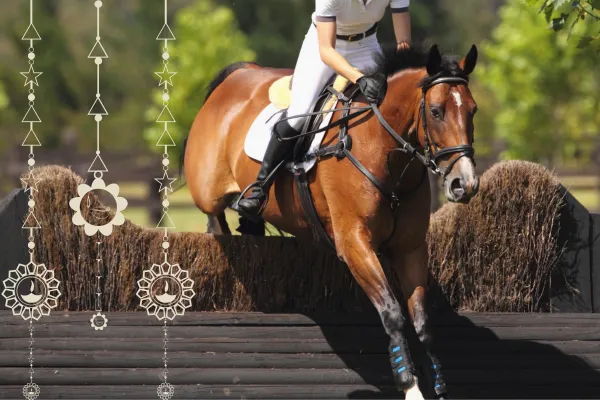
When I was a teenager, I rode horses competitively and competed in eventing, which is a discipline that combines dressage, show jumping, and cross country. The cross country phase was always the most daunting part of the event. You would gallop across open terrain at speed, navigating a course filled with large, solid obstacles designed to test both the horse and the rider.
They were intimidating by design.
Some of the jumps didn’t even look like jumps at all. They might resemble logs, banks, walls or water complexes that, at first glance, seemed almost illogical to approach at speed on a horse. Standing in the starting box at the start of the course waiting for my countdown to commence, I remember feeling a mixture of exhilaration and deep uncertainty.
There was a part of me that genuinely wondered how anyone could possibly feel confident doing something like that. My heart would be racing a thousand miles an hour.
In my mind, riders who competed at higher levels seemed almost fearless. It felt as though they must possess some kind of natural bravery that I simply didn’t have.
At the beginning of my competition years, I honestly believed that certain courses, certain obstacles, and certain levels of the sport were simply beyond what I was capable of doing. I would walk the course beforehand, looking at the jumps and mentally cataloguing which ones felt manageable and which ones felt impossible.
But something interesting happened over time.
As I competed more frequently and gradually moved up through the levels, my ability didn’t suddenly transform overnight. I didn’t wake up one day with entirely different riding skills or a completely different horse.
What shifted was something far more subtle.
My perception changed.

The same types of obstacles that once looked enormous and intimidating began to look … achievable. Not easy, necessarily, but possible. My nervous system had experienced them enough times that they no longer triggered the same level of alarm. The jumps, in terms of difficulty hadn’t changed. The course designers certainly hadn’t decided to make them less challenging for that specific level.
What had changed was the filter I was looking through.
The more experiences I accumulated successfully navigating those courses, the more my mind began categorising those situations differently. What once registered as danger slowly started to register as challenge. The jumps that once made my stomach tighten began to feel like something I could approach with focus rather than fear.
Looking back now, I can see that what shifted wasn’t really my ability.
It was my perception of what I believed was possible.
The brain had updated its filter.
“Everything you’ve ever wanted is on the other side of fear.”
- George Addair
This is where understanding the Reticular Activating System becomes incredibly powerful, because it reveals that our experience of life is rarely about reality alone. It is about the interaction between reality and the internal patterns we bring to it.
If somewhere in your conditioning you have learned to expect rejection, your nervous system will quietly highlight cues that confirm that expectation. If you have learned that success is unsafe or visibility leads to criticism, your attention will drift toward every signal that supports that story.
And when something stretches you - when you consider starting something new, speaking up, making a change, or stepping into a bigger version of your life - your system will often respond with fear.
Most people interpret that fear as a sign that something is wrong.
But fear is simply the nervous system responding to the unfamiliar.
Growth almost always introduces unfamiliar territory.
Just as it did standing at the start of those cross country courses, thinking about jumps that initially felt far beyond what I could handle.
Over time I realised that the riders who appeared fearless weren’t actually free from fear at all. What they had developed was a different relationship with it. They had accumulated enough experiences moving through that fear that their nervous systems no longer treated those situations as immediate threats.
Their filter had changed.
And the same thing happens in every area of life.
The fear of starting becomes the fear of being seen. The fear of being seen becomes the fear of sustaining success. The challenges evolve as you evolve, but the mechanism inside the nervous system remains remarkably similar.
The goal, then, isn’t to reach a point where fear disappears.
The goal is to recognise that the filter through which you experience fear can change.
Every time you move forward while feeling uncertain, every time you allow yourself to experience discomfort without immediately retreating from it, your system gathers new evidence. Slowly, quietly, your perception updates. What once seemed impossible begins to look achievable.
And eventually you realise something that can feel both humbling and empowering at the same time.
The world didn’t suddenly become easier.
You simply began seeing it through a different lens.
The filter shifted.
And with that shift, what once looked terrifying now looks like the next natural step forward.
“The real voyage of discovery consists not in seeking new landscapes, but in having new eyes.”
- Marcel Proust